In 2018, twelve former members of Ukraine’s disbanded Tornado special police company stood convicted after a trial held behind closed doors. Eight received prison sentences totaling seventy-four and a half years; four received five-year suspended sentences. Long before the court delivered its judgment, the men had already been condemned in public. Ukraine’s chief military prosecutor, Anatoly Matios, had appeared on national television to describe a basement in Lysychansk where Tornado fighters allegedly tortured, sexually abused, and terrorized civilians. Politicians and media repeated even more extreme accusations. The unit’s name became synonymous with depravity before the defendants were permitted to answer their accusers in an open courtroom.
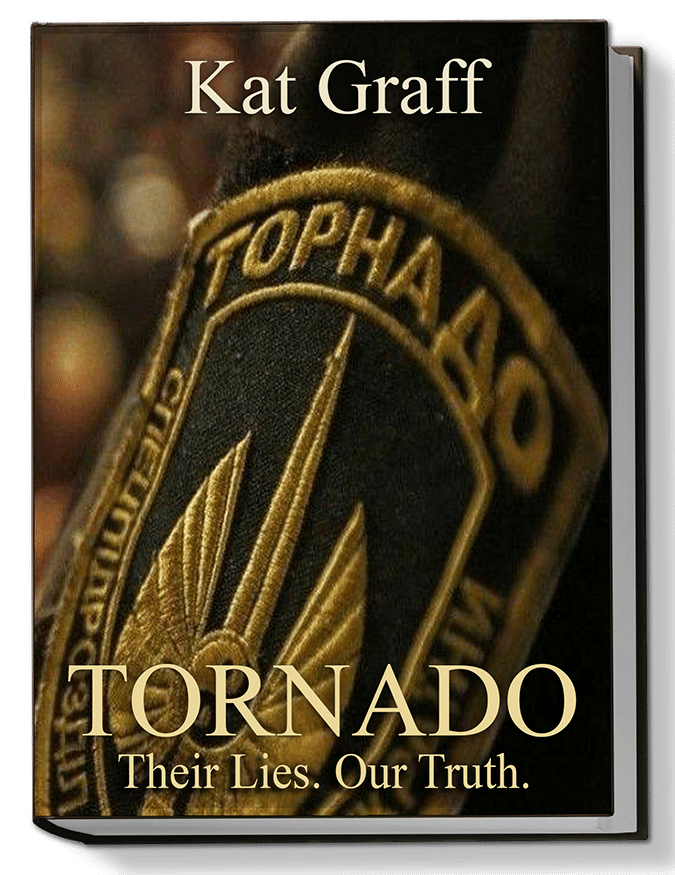
Tornado: Their Lies. Our Truth. is Kat Graff’s documentary defense of those men and her indictment of the political, military, prosecutorial, and commercial system that destroyed their unit. Graff does not claim that a book can substitute for a court or provide a legal acquittal. Her stated purpose is to make public what a closed process concealed: testimony sent to her by the imprisoned Tornado fighters, the sequence of events preceding their arrest, their account of the smuggling networks they tried to stop, the contradictions they identify in the prosecution’s case, and the backgrounds of the officials who pronounced them guilty before judgment.
The book begins with the volunteer movement created by Russia’s attack on Ukraine in 2014. When Crimea was occupied and Russian forces and their local proxies moved into the Donbas, Ukraine’s regular army was unprepared. Citizens went directly from the Maidan to the front. Volunteers and their families bought equipment, while an entire civilian support network collected money, repaired vehicles, imported body armor, cooked food, and carried supplies under fire. Men from radically different backgrounds—workers, students, teachers, doctors, business owners, former prisoners, and military veterans—joined the same improvised units because the state could not defend the country without them.
Graff argues that the qualities that made these volunteers effective also made them dangerous to the post-Maidan authorities. They chose commanders whom they trusted, resisted tactically senseless orders, refused to conceal losses, and regarded equality and justice as conditions of collective survival. They were prepared to die in combat, but not to obey officers who treated them as expendable or to ignore officials profiting from the war.
Tornado grew out of the Shakhtarsk volunteer battalion. Its nucleus consisted of pro-Ukrainian residents of the Donetsk and Luhansk regions who had resisted Russian-backed separatists before Kyiv organized meaningful support. Small underground groups gathered intelligence, destroyed separatist propaganda facilities, captured militants, and transferred them to the Ukrainian security services. When their bases were attacked by Russian-backed forces with armored vehicles and heavy weapons, Ruslan Onishchenko’s group rescued wounded comrades from a guarded hospital and fought its way to Ukrainian-controlled territory.
Shakhtarsk operated as an assault unit, attacking and clearing positions before handing them over to regular forces. At Pisky, its fighters marched thirteen kilometers carrying ammunition, water, and medical supplies after promised transport failed to arrive, then entered combat immediately. At Ilovaisk, they fought without adequate reconnaissance, coordination, armor, artillery support, protective equipment, or common radio frequencies. Onishchenko ultimately divided his men into smaller groups and withdrew before Russian forces sealed the encirclement, preserving most of the battalion.
One episode encapsulates the book’s argument about the state’s treatment of volunteers. Shakhtarsk fighters found almost one hundred new armored personnel carriers in the port of Mariupol awaiting export to Thailand. With Ilovaisk ahead and their own unit lacking armor, they intended to take ten into battle. Prosecutors, generals, Interior Ministry officials, and politicians called Onishchenko and ordered him to leave the vehicles untouched, promising tanks and armored support the following day. Instead, the unit received two malfunctioning infantry vehicles and almost no ammunition. Eleven volunteers were killed; the new carriers went abroad.
Shakhtarsk was dissolved by Interior Minister Arsen Avakov in October 2014 for discrediting the police. The official explanation centered on looting and indiscipline. Tornado’s fighters give another account. A group that remained separate from Shakhtarsk’s command was filmed surrounded by drugs and syringes and later removed vehicles, food, medicine, and weapons from the base. Reports of its criminal behavior were then attributed to the entire battalion.
The decisive confrontation came during the 2014 parliamentary election. Shakhtarsk received an oral order to remove its unit markings, join other armed groups, and disrupt eleven polling stations. At the designated meeting point, Onishchenko discovered local criminals and plainclothes police among the men assigned to the operation. His fighters disarmed and detained them after a shootout instead of attacking the polling places. The detainees were released on a general’s instructions. Days later, an Alpha security unit attempted to storm Shakhtarsk’s base. No blood was shed, but the battalion was soon disbanded.
Forty-seven Shakhtarsk fighters formed the core of the new Tornado special police company. In December 2014, after minimal or no training, 110 of its men were sent to Stanytsia Luhanska. They held two forward positions for ninety-eight days with small arms, scarce ammunition, and no prepared trenches or shelters. In one battle, they rescued twenty-six National Guard soldiers whose bus had driven into an enemy checkpoint and recovered two Ukrainian dead.
The conflict that led to Tornado’s destruction began with smuggling.
In early 2015, Tornado patrols started intercepting cigarettes, food, alcohol, medicine, timber, scrap metal, coal, and other cargo moving across the front line. Only their daytime presence was authorized; at night another Interior Ministry unit allowed hundreds of trucks through. When they reported the traffic, senior officers told them that because Ukraine had not formally declared war, there could be no enemy and therefore no contraband—only a “minor misunderstanding” in which people happened to be fighting and dying.
Tornado continued inspecting vehicles. Its men detained trucks without documents, reported their cargo, and watched the same vehicles disappear from official impound lots. They documented coal taken from state mines, industrial equipment cut apart for metal, supplies stolen from military warehouses, and convoys moving to and from occupied Luhansk. They were ordered to allow vehicles escorted by favored intermediaries to pass without inspection. Complaints sent to the Luhansk police command, the Interior Ministry, and the presidential administration produced threats rather than investigations.
One blocked route carried between two hundred and three hundred fifty trucks every night, generating millions of hryvnias for networks protected by police and military commanders. The unit refused an offer of money to reopen it. When Russian-backed forces offered to return fifteen Ukrainian prisoners in exchange for partial access to the road, Tornado negotiated an agreement witnessed by OSCE representatives. Its own command rejected the exchange and threatened to fire upon the battalion unless the blockade was lifted. Onishchenko withdrew to prevent bloodshed between Ukrainian units. The bridge on that road was destroyed the following day.
The book documents Tornado’s confrontations with Ukrainian personnel who were stripping abandoned homes, dismantling industrial plants, and transporting coal, timber, metal, and stolen machinery across the front. The fighters surrounded the looters, summoned military police, documented loaded vehicles, and refused orders to ignore the convoys.
By June 2015, Tornado was working with other anti-smuggling groups and members of the Donbas battalion. At Hirske and Svitlanove, they stopped railway trains arriving from occupied territory without documents. On June 16, Tornado detained twenty wagons of pig iron and eleven wagons of coke material worth tens of millions of hryvnias. Nikolai Tsukur published the documents and reported that Onishchenko had received calls throughout the night ordering him to release the train.
On June 17, seven Tornado members, including Onishchenko, were arrested. Avakov ordered the unit dissolved the following day.
The book identifies a second source of retaliation. After Ilovaisk, Onishchenko sought a meeting with Chief Military Prosecutor Anatoly Matios, believing that testimony from a commander who had fought there would help identify those responsible for the catastrophe. Matios refused to hear his evidence. Instead, two officials gave Onishchenko a prepared statement to read on camera—a statement falsely assigning responsibility to politically convenient scapegoats. He tore it up, denounced the prosecutor, and spat in Matios’s face. Onishchenko records Matios’s answer: a man who insisted on his own opinion would go to prison.
Once Tornado’s commanders were detained, Matios publicly described horrific crimes before a trial began. The proceedings were then closed, officially to protect victims whose dignity might be harmed by disclosure. Graff points to the central contradiction: secrecy prevented public examination of the evidence while officials and politicians freely broadcast the most inflammatory accusations.
The documentary core of Their Lies. Our Truth. sets the prosecution’s account beside testimony, expert findings, procedural records, and the defendants’ explanations. Men formally employed as mechanics, communications specialists, or civilian technicians were charged with unlawfully assuming police powers because they wore camouflage and fought beside the unit in a combat zone. Other charges arose from arrests made during joint police patrols whose formally designated leaders had failed to document detainees correctly.
One charge of vehicle theft concerned a car found in the garage of a separatist bomb-maker, with wiring and explosive components in its trunk. Months later, the man’s wife accused Tornado’s commanders of taking the vehicle for themselves, while proceedings concerning her own involvement with Russian-backed formations were closed.
The sexual charge used to justify closing the trial came from a woman who had left Tornado with another member, taking service weapons and documents. She made no complaint until after the arrests. The allegation concerned unwanted touching and a proposition—not the rapes, abuse of children, or filmed atrocities later proclaimed by politicians. Medical, DNA, and other expert examinations reproduced in the book failed to corroborate the torture described by the prosecution. Direct witnesses were absent, and several defense witnesses died before they could testify.
The defendants demanded an open trial. Instead, hearings were postponed, access to case materials was delayed, family visits were restricted, and the men were pressured to testify against one another. On August 9, 2016, nine defendants were taken individually into a lower room of Kyiv’s Obolon District Court, stripped, searched, and beaten by masked men. Tsukur describes being kicked and struck with batons until he repeatedly lost consciousness, then being carried into the courtroom in tightened handcuffs.
On April 7, 2017, the court imposed prison sentences ranging from eight to eleven years upon eight defendants; four others received suspended sentences. Appeals were filed, but the convicted men were not given timely access to the enormous case record. At the time Graff completed the book in 2018, they had been separated among different prisons, their legal papers had been confiscated, and Onishchenko was held alone under constant light and video surveillance.
The second part of the book, “The Untouchables,” turns from the accused to the accusers: Anatoly Naumenko, Gennady Moskal, Vladimir Yevdokymov, Anatoly Matios, Arsen Avakov, Serhiy Pashynsky, and Tetiana Chornovol. Drawing on public records, investigative reporting, interviews, and the fighters’ testimony, Graff maps a network in which Soviet police habits, post-Soviet organized crime, political patronage, wartime commerce, prosecutorial protection, and media influence reinforce one another.
Naumenko occupies the center of this account. Graff documents the Luhansk police chief’s protection of industrial-scale traffic across the front, organized looting, and the theft of coal, metal, timber, factory equipment, church valuables, and private property. The remaining profiles show how officials, prosecutors, politicians, and media figures protected the wartime system and publicly transformed Tornado into a symbol of criminality. The most sensational claims—including accusations involving rape and infants—never appeared in the prosecution’s own list of charges.
Graff’s language is openly furious and partisan. Their Lies. Our Truth. is not written as a detached institutional history. It is advocacy, documentary polemic, and an attempt to preserve voices excluded from the official record. Its appendices include an appeal to United Nations human-rights representative Nils Melzer, contemporary reporting from Ilovaisk, accounts of life inside volunteer units, public statements, news reports, and extended testimony from the accused.
The book does not ask readers to treat wartime service as immunity from criminal responsibility. Tsukur’s own formulation is explicit: if they are guilty, they should go to prison. What the defendants demand is a public process in which the accusations, witnesses, expert evidence, orders, and commercial interests surrounding their case can be examined together.
At the center of Tornado is therefore a question larger than the fate of one battalion. What happens when a state depends upon armed volunteers for survival, but retains institutions built upon corruption, secrecy, and obedience? What happens when men who have been told to fight an enemy discover that officials on their own side are conducting business across the line of fire? And who is declared criminal when those men refuse to remain silent?
The official narrative called Tornado a criminal organization masquerading as patriots. Graff’s documentary counter-narrative presents another possibility: that the men were imprisoned not because the system discovered what they had done in secret, but because they exposed what the system was doing in plain sight.