Pushkin, Tolstoy, and the Burden of Genius
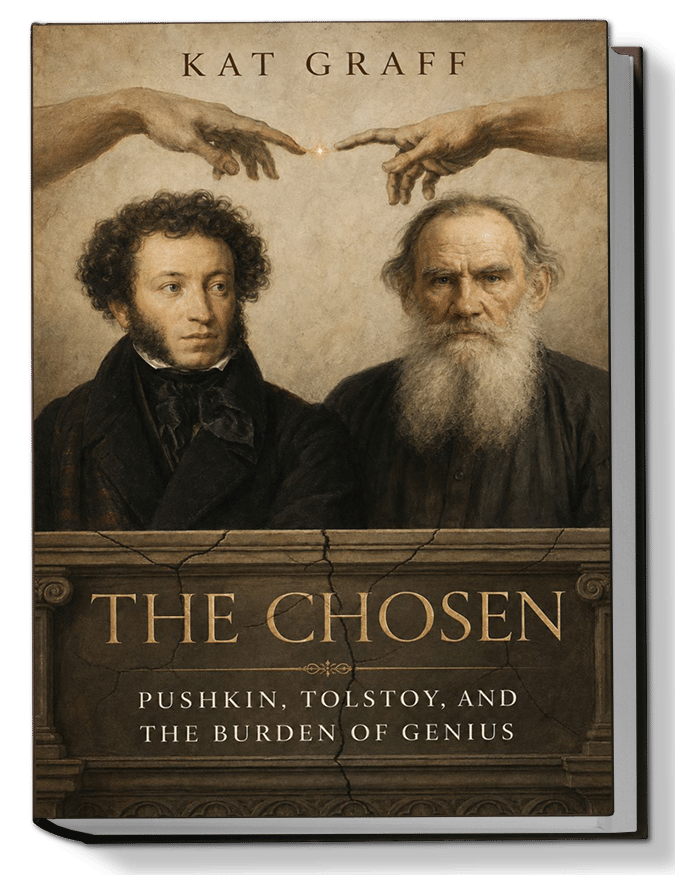
In Michelangelo’s fresco on the ceiling of the Sistine Chapel, God reaches toward Adam and almost touches his hand. The space between their fingers contains the mystery of creation: the moment when life, reason, and possibility pass from the divine to the human.
Michelangelo understood the image from within. He believed that his own genius was a gift from God, but he added to that gift an almost inhuman capacity for work. He endured humiliation, resisted popes, obeyed his father, fought for his art, and lived long enough to transform what he had been given into immortality.
For Kat Graff, the relationship between genius and God is a road with two tracks, running in opposite directions. God touches the chosen one and bestows a gift. Then He waits to see what the human being will do with it. Will the chosen one master his talent, withstand suffering, and create something worthy of the gift? Or will he dissipate it through vanity, pleasure, weakness, and self-destruction?
The Chosen examines two men whose place in Russian literature appears unassailable: Leo Tolstoy and Alexander Pushkin. Graff does not deny the power of their greatest works. She denies that genius grants moral immunity or that a nation’s ideological needs should determine how its writers are remembered.
For seventy years, Soviet ideologues treated literature as state property. History became the history of the Bolsheviks, the Revolution, and the Communist Party. Writers who had lived before 1917 were rewritten as precursors of the new order. Tolstoy became “the mirror of the Russian Revolution.” Pushkin became a freedom fighter and political martyr destroyed by the monarchy.
Both transformations were useful. Tolstoy had condemned the Church, autocracy, wealth, private property, and the educated classes while attributing moral purity to ordinary people. Pushkin had written rebellious verse, attacked the government, and mocked the aristocracy to which he himself belonged. The Soviet state appropriated them, corrected their contradictions, concealed inconvenient elements of their lives, and placed them upon pedestals.
Graff removes them from Soviet ownership. Then she removes them from the pedestals.
Her argument is not that great art must be created by saints. It is that extraordinary talent imposes an extraordinary responsibility. Pushkin and Tolstoy were chosen not first by the Bolsheviks, but by God. The question is what they did with that distinction.
Leo Tolstoy: The Rebellion Against Himself
Tolstoy began keeping diaries at eighteen. His early self-portrait is merciless: physically unattractive, awkward, unclean, socially uneducated, irritable, vain, lazy, indecisive, intolerant, and weak-willed. He believed himself intelligent but admitted that his intelligence had never been properly tested.
He left military service, married Sophia Behrs, fathered children, stopped keeping regular diaries, and wrote War and Peace and Anna Karenina. Eighteen years later, systematic diary entries resumed. By then Tolstoy was undergoing the spiritual crisis that would define the second half of his life.
He repented.
In the conventional version of Tolstoy’s life, this crisis marks a profound moral awakening. Surrounded by poverty, Tolstoy suddenly understood the obscenity of his own privilege and the injustice of the social order. He became disgusted with wealth, power, government, organized religion, and himself. He wrote repeatedly of his shame, his desire to leave his family, and his wish to live among ordinary laborers.
Yet he did not leave.
He continued to live as Count Tolstoy, surrounded by the estate, reputation, family labor, and material security that made his renunciation possible. He condemned the life of privilege while remaining its most celebrated occupant. He dreamed aloud of abandoning everything, but allowed his wife and children to bear the emotional consequences of a sacrifice he continually announced and continually postponed.
Graff asks whether Tolstoy’s repentance transformed his life or merely became another form of self-absorption. Russian culture has often treated suffering over one’s sins as almost more important than ceasing to commit them. Tolstoy’s diaries offer an extreme version of that temptation: the self-torture of confession, indulged without the finality of change.
His proclaimed love of the people is subjected to the same examination. Tolstoy idealized the peasant, praised natural wisdom, and assigned special morality to the “great majority.” In private, however, he wrote of the difficulty of loving people without despising them, compared the proper attitude toward them to one’s attitude toward animals, complained about petitioners, and admitted that he could not treat eight ragged visitors humanely.
Maxim Gorky recognized the contradiction. Beneath Tolstoy’s peasant shirt and democratic beard, Gorky saw the old Russian master emerge – an aristocrat capable of freezing those around him with a gesture or a sentence. There was, Gorky suggested, exactly enough of the barin in Tolstoy for a country of serfs.
Graff then turns from the diaries to Tolstoy’s moral imagination. In The Power of Darkness, a murdered infant becomes the precondition for repentance and purification. In Resurrection and The Divine and the Human, criminals and revolutionary terrorists pass through guilt, imprisonment, and suffering before emerging morally transformed.
But why, Graff asks, must a person first commit a terrible act in order to attain moral height? Is morality without a preceding crime not the human norm? Repentance cannot resurrect a murdered child, however profoundly the murderer suffers.
Tolstoy’s idealization of the people is also tested against the Revolution he did not live to see. The supposedly gentle, moral laborer did not become an independent and humane judge of the old order. Under new masters, portions of the people participated in confiscations, executions, denunciations, and violence. The slave of the landowner became the slave of the revolutionary leader. If genius carries an obligation to see farther than ordinary intelligence, should Tolstoy have recognized what could emerge from the forces he romanticized?
His vision of art brings him still closer to the culture that later claimed him. Tolstoy rejected technical sophistication, formal refinement, and the exceptional feelings of the chosen. Art, he argued, should become universal, simple, accessible, and devoted to the life of the working person. In that formulation, Graff hears an anticipation of socialist realism – the art Soviet citizens would be required to consume for seven decades.
Lenin understood Tolstoy’s usefulness. The writer opposed Church authority, monarchy, serfdom, wealth, and the state. He praised agricultural labor, imagined life without money and armies, and opened a school for poor children at Yasnaya Polya
na. His contradictions could be forgiven. The revolutionary canon had found its pre-revolutionary prophet.
The Tyrant at Home
A private rebellion becomes tyranny when one person requires an entire family to live inside it.
Tolstoy’s writings about women are unambiguous. He claimed that women gave birth to children but not to thought; blamed them for destroying courage, reason, justice, and firmness in men; and described them as incapable of moving in accordance with reason. Graff traces this hostility to the writer’s own sexual past. Unable to forgive his youthful debauchery, Tolstoy turned male desire into female guilt. Woman became the cause of temptation, and therefore the bearer of the man’s sin.
Sophia Tolstaya spent years serving both the writer and the family. She bore and raised children, copied his manuscripts, negotiated with publishers, administered literary affairs, and preserved the practical world in which his genius could operate. When she resisted his desire to renounce property and leave their children without security, he treated her refusal as moral inferiority.
Graff examines The Kreutzer Sonata and Father Sergius as expressions of the same conflict. Love in the later Tolstoy becomes contaminated by revulsion. Sexuality produces guilt; women embody temptation; the body appears as evidence of spiritual failure. The man who wrote some of literature’s most profound scenes of human intimacy increasingly treated physical love as something from which the soul must escape.
That contradiction leads to the central mystery of the Tolstoy section.
Who Wrote the Masterpieces?
Graff does not announce that Tolstoy failed to write War and Peace or Anna Karenina. She asks how the man revealed in his diaries could have written them.
War and Peace appears to her radically unlike Tolstoy’s other fiction. The novel is illuminated by love: love of people, family, history, nature, imperfection, and life itself. Yet Tolstoy’s diaries contain remarkably little about the creation of this immense work. The book seems to appear in his life without the prolonged spiritual and intellectual struggle or the sustained preparatory work one might expect.
The novel also contains a depth of military, aristocratic, political, and European experience that invites another question. Could some part of it have originated in an earlier manuscript written by a Decembrist – an educated military aristocrat who had participated in the war against Napoleon, known the imperial world from within, encountered Kutuzov, and later returned from Siberian exile with his family?
Graff presents this as a conjecture, not a verdict. She notices the dissonance between the novel and the man, draws out the thread, and leaves the remaining knot for another researcher.
Anna Karenina creates a different but related problem. In 1878, the critic A. V. Stankevich argued that the book contained not one novel, but two: the story of Anna and the story of Levin, running beside one another without true structural dependence.
Graff takes that observation further. Anna’s story belongs to the tradition of the great society novel: a passionate woman trapped among desire, law, convention, error, and social judgment. The emotional world of Anna Karenina recalls Madame Bovary and The Lady of the Camellias, but the novel’s psychological depth is distinctly Russian. Levin’s story, by contrast, is unmistakably Tolstoyan. It begins before Anna’s and continues after her death, surrounding her tragedy with the author’s spiritual self-portrait and his theology of punishment.
Could Tolstoy, whose diaries reveal contempt for women and disgust toward physical love, have created Anna’s inner life with such compassion? Or did he place Levin’s moral and philosophical framework around another story?
Again, Graff does not claim to have solved the mystery. She states precisely where her certainty ends: she does not assert that Tolstoy did not write the novels. She asks how he could have written them. Nearly everything else in his literary legacy corresponds to the personality and worldview preserved in his diaries. These two books do not.
The Tolstoy section concludes with a comparison between his worldview and Dostoevsky’s, followed by a detailed reconstruction of Tolstoy’s final conflict with Sophia and his fatal flight from home. The prophet who spent decades speaking of departure finally left – old, ill, and pursued by the drama he had helped create.
Alexander Pushkin: The Gift Squandered
If Graff questions the supreme form of Tolstoy’s talent, she has no doubt about Pushkin’s. He received genius in full measure. Such a gift appears perhaps once in several centuries.
Pushkin could have lived a long life. Longevity ran in his maternal family. But he could have lived only on one condition: he would have had to become a different man.
He died at thirty-seven, after a duel with Georges d’Anthès. Why was he permitted only half of an ordinary human life?
Graff reconstructs Pushkin’s biography through letters, diaries, memoirs, contemporary testimony, and research into the poet’s final years. Her principal target is the Soviet narrative that transformed a destructive family drama into a political assassination.
The pre-revolutionary historian Pavel Shchegolev, whose study The Duel and Death of Pushkin appeared in 1916, identified many pressures upon the poet: financial, literary, political, social, and personal. Yet he regarded Pushkin’s family relationships as the immediate cause of the fatal collision. Anna Akhmatova also resisted the political mythology surrounding the death.
Soviet Pushkin scholars needed a different ending. The poet had written rebellious verse and attacked autocracy; therefore he could be presented as a fighter for the oppressed, destroyed by Nicholas I and the monarchical system. His sexual recklessness, vanity, debts, dependence upon the court, and disastrous domestic life had to be softened or concealed. His wife, Natalia Goncharova, became a Madonna-like figure of purity. Her sisters were incorporated into the same mythology.
The banal duel became political martyrdom.
The Revolutionary Who Did Not Revolt
Pushkin’s language could be ferocious. He insulted government officials, generals, aristocrats, priests, and the ruling order. He spoke of hanging nobles and was associated with some of the period’s most violent epigrams. Such statements made him useful to later revolutionaries.
But speech is not action.
Pushkin wanted freedom, particularly his own. He did not want poverty, imprisonment, Siberian exile, or equality with the peasant whose liberation he praised in verse. He took great pride in the antiquity of his noble lineage. He longed for recognition at court, money for his work, access to society, and an official historical position.
The Decembrists knew his opinions but did not trust him with their secrets. His former schoolmate Ivan Pushchin considered revealing the existence of the secret society to him, the
n decided that Pushkin’s volatility and indiscretion made the risk too great. They expected Pushkin’s poetry to awaken the nation, but never trusted the poet himself enough to admit him into their political circle. Pushkin had opportunities to turn conviction into action. He could have joined the Decembrists, shared their danger, and followed them into exile. Instead, he remained outside the movement and later signed declarations that he had never belonged to a secret society and would not join one. He denied authorship of The Gabrieliad when ecclesiastical prosecution threatened him.
Graff does not condemn the desire for personal safety. She challenges the later transformation of caution into heroism.
Nicholas I monitored Pushkin, restricted him, opened some of his private letters, and subjected his writing to personal censorship. But the emperor also granted him leave, appointed him to service, paid him a salary, lent him money without interest, read his historical work on Pugachev, and gave him privileged access to Catherine the Great’s archives and Voltaire’s library.
If Nicholas had wished to eliminate Pushkin, Graff argues, he possessed far simpler means than an elaborate conspiracy involving d’Anthès, Baron Heeckeren, Natalia, and Natalia’s sisters.
Women
Women were Pushkin’s most persistent and destructive appetite. His own Don Juan list contained 113 names. Even while seeking marriage, he continued to move among new and former objects of desire.
Graff reproduces his letter to Pyotr Vyazemsky concerning a young woman who had become pregnant and whom Pushkin wanted quietly sent away, with separate arrangements made for the child. She follows his failed proposals, scandals, affairs, and contradictory attachments, including the passionate letter he wrote to Karolina Sobańska while pursuing marriage to Natalia Goncharova.
Marriage did not end the pattern. Pushkin became entangled in the lives of his wife’s sisters, while the household itself became increasingly unstable. Natalia and two of her sisters were drawn into the orbit of d’Anthès; another sister complicated Pushkin’s domestic world in a different way. Even Vyazemsky, one of Pushkin’s oldest friends, eventually turned away from the atmosphere inside the poet’s home.
Graff concludes that Natalia’s involvement with d’Anthès was not an innocent invention of hostile society. The final year before the duel became a feverish mixture of flirtation, humiliation, sexual rivalry, gossip, vanity, and spectacle. Pushkin himself described d’Anthès as handsome and kind and called his attachment to Natalia a great and elevated passion—yet ultimately challenged him to the duel that killed him.
The question is no longer simply whose honor Pushkin defended. By then, the entire household had become incapable of distinguishing love from vanity and honor from public humiliation.
Money
The final years of Pushkin’s life were also dominated by debt.
His parents’ estates were mortgaged. His brother Lev spent freely and placed obligations upon Alexander. Natalia required gowns and a social life suitable for court. Her unmarried sisters lived in the Pushkin household and added to its expense. Pushkin himself remained attracted to salons, entertainment, intrigue, women, and the aristocratic world that never fully accepted him.
His annual expenditure reached approximately thirty thousand rubles, while his income failed to cover even half. He borrowed repeatedly, including from Nicholas I. In a draft appeal transmitted through Benckendorff, Pushkin proposed that the emperor replace his annual salary with an interest-free loan of one hundred thousand rubles.
The contradiction was humiliating. The poet accepted imperial favor with one hand while writing epigrams against the monarch with the other. He wanted freedom from the same power upon which his family’s survival increasingly depended.
Gogol wrote bitterly that Pushkin had almost ceased working during his final years. The poet’s mind was occupied by debts, society, domestic chaos, and the public drama surrounding his wife. His talent – the one possession capable of rescuing him - was left waiting.
Vasily Zhukovsky had warned him years earlier:
“Stop being an epigram; become a poem.”
The final chapter of The Chosen reconstructs the weeks before the duel, the confrontation itself, Pushkin’s wound, and his death as a detective investigation. Every participant possesses a motive, a fear, or a private interest. The evidence leads not toward a secret order from the emperor, but inward - toward the Goncharov family, d’Anthès and Heeckeren, the poet’s debts, his wounded vanity, and the household drama from which he could no longer escape.
Natalia was not necessarily conscious of herself as an agent of fate. Some people become fatal to others without intending to. From the beginning, everything in Pushkin’s life seemed to lead him toward her. She, in turn, led him toward his death.
The Judgment of Genius
The Chosen does not ask readers to stop admiring War and Peace, Anna Karenina, or Pushkin’s poetry. It asks them to stop confusing artistic genius with moral authority.
The Soviet state needed spotless ancestors. It transformed Tolstoy’s contradictions into revolutionary prophecy and Pushkin’s self-destruction into political martyrdom. Graff restores what ideology removed: vanity, cowardice, cruelty, lust, dependence, domestic tyranny, failed repentance, and the ordinary human weakness hidden beneath monumental names.
But her judgment is not merely political. It is theological.
Tolstoy and Pushkin were given something almost no one receives. Their gift belonged to them, but its source did not. Genius offered them the possibility of creating immortality and adding human glory to the glory of the Creator. It did not absolve them from the obligation to become equal to what had been placed within them.
Tolstoy spent decades preaching renunciation while ruling his household like a despot and leaving behind two masterpieces whose relationship to his personality remains a mystery. Pushkin possessed unquestioned genius but allowed his life, time, freedom, and talent to be consumed by debt, society, women, and wounded pride.
One may be chosen by God. One may later be chosen by an empire and turned into a monument. Neither form of election answers the final question:
Was the chosen one worthy of his gift?