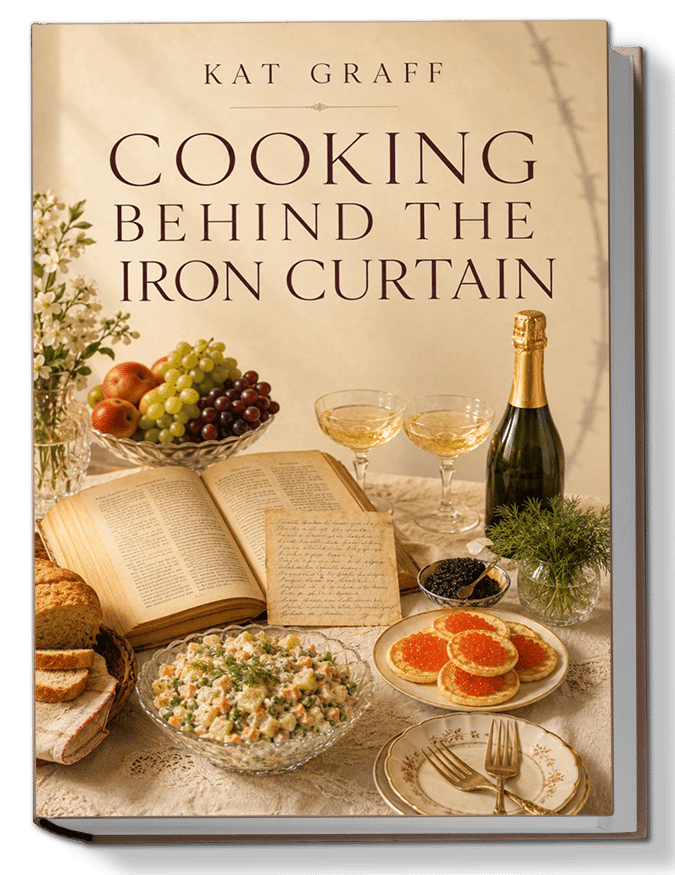
Cooking Behind the Iron Curtain
Cooking Behind the Iron Curtain opens with a preface rooted in family memory. For as long as Kat Graff can remember, her family has kept three heavy, well-worn cookbooks published in the early 1950s. As a girl, she loved turning their thick pages, studying the colourful illustrations and photographs, and discovering between them scraps of paper—and sometimes even paper napkins covered with recipes in her grandmother’s tiny, hurried handwriting. Years later, when she learned to cook, she also learned to decipher those precious notes and cook from them. Whenever she needed another recipe, she would plunge into the depths of the old volumes, always passing over their introductory essays without a glance. Only much later did she return to those neglected opening pages - and discover how the Soviet state had claimed a seat at the tables of millions of families.
When she finally read them, she discovered something extraordinary. The cookbooks opened with addresses from the Communist Party to the Soviet people. Only eight years after the end of the Second World War, while cities still lay in ruins and millions of families were rebuilding their lives, party ideologues used the pages of cookbooks to proclaim abundance, prosperity, and the imminent triumph of communism. They advised cooks to educate the public taste and encouraged ordinary citizens to appreciate asparagus, oysters, delicacy cheeses, and other foods unavailable to most of them.
The discovery becomes the starting point for Cooking Behind the Iron Curtain, a hybrid of political and cultural history, personal memoir, social criticism, and family cookbook. Graff examines the Soviet Union through the most ordinary and indispensable element of human existence: food. Bread, privilege, hunger, celebration, propaganda, memory, and domestic love belong to the same history. What people place on their tables reveals not only their means and tastes, but the political system under which they live.
Graff rejects two competing myths. The first is the official Soviet fantasy of universal prosperity, social justice, and historical progress. The second is the simplified Western image of a uniformly gray country in which everyone lived in poverty and stood in endless lines for rotten fish. The reality behind the Iron Curtain was much more contradictory.
The Soviet system produced terror, censorship, camps, executions, political persecution, exile, and the destruction of independent thought. It also created a strong educational tradition, accessible medical care, economic predictability, remarkable schools of music, theatre, ballet, literature, and scientific achievement. People read forbidden books in samizdat while preserving family rituals that had little to do with the state. They listened to Okudzhava, Brodsky, Pasternak, and Lina Kostenko. They argued in kitchens, celebrated New Year with Olivier salad and Soviet Champagne, and found private forms of dignity inside a system determined to regulate public truth.
The first major section, “Political Cuisine,” follows the history of the Soviet empire through its rulers, its writers, its kitchens, and its tables. The Communist Party did not merely control government, labor, education, publishing, and travel. It entered the domestic sphere, prescribing what people ought to eat and how Soviet cooks should cultivate proletarian taste.
Lenin dreamed of liberating women from the burden of private housekeeping and replacing the family kitchen with communal institutions. Graff considers what became of that promise, along with the women Lenin married and loved, the food prepared for him by his mother, his wife, and the Kremlin cooks, and the curious fact that Vladimir Putin’s grandfather later worked as a cook in Gorki, where Lenin spent his final years.
The narrative moves through Stalin’s childhood, private life, favorite dishes, and three decades of rule. The intimacy of food exists beside the machinery of terror: political purges, the destruction of entire social groups, and laws that allowed children as young as twelve to face the highest punishment. The table of the ruler and the hunger of the ruled belong to the same political cuisine.
The book then passes through the Second World War, Khrushchev and the persistence of Stalinism, the comparatively hopeful 1960s, the observations of Simone de Beauvoir during her Soviet travels, the emergence of stilyagi and Beatlemania, and the long Brezhnev era. It considers glasnost, perestroika, the Afghan war, the dissident movement, the distribution of privilege, the revocation of citizenship, and the cultural nomenklatura. Graff asks who makes history – God, exceptional individuals, or the people – and how a society that proclaimed universal equality created its own protected caste.
Political history is interwoven with literature. Graff draws upon Anatoly Rybakov, Simone de Beauvoir, Mikhail Bulgakov, Albert Camus, Anna Akhmatova, Aleksandr Solzhenitsyn, Nikolai Berdyaev, Alexei Tolstoy, Nikolai Gogol, and Ivan Goncharov. Their works become intellectual ingredients: descriptions and testimonies capable of recovering periods that the author did not witness herself or experienced only as a child.
The story also descends from the Kremlin into public dining rooms, restaurants, food shops, markets, communal kitchens, and private homes. Graff writes about official daily menus proposed to Soviet housewives, celebrated restaurants visited by Sartre and de Beauvoir, banquets prepared for foreign leaders, food queues, regional delicacies, caviar, fish, traditional holidays, Russian baths, Maslenitsa, and pancakes. Political history gradually merges with family history: hunting and fishing, stolen flower cuttings and watermelons, and two gifted cooks - Graff’s grandmother and her grandmother’s elder sister.
After the horrors and absurdities of “Political Cuisine,” the reader cannot reasonably be expected to sit down and eat. Graff therefore inserts “The Drinking Section” as a buffer between political history and the family table. First, everyone needs a drink.
The section moves from moonshine, village distillers, and the perennial summer shortage of sugar to kvass, fruit liqueurs, vodka, cognac, Soviet wines, and champagne. Graff explores the history of Russian “bread wine,” flavored vodkas, Mendeleev’s association with the national drink, drinking customs, and the relationship between cognac and herring in the Soviet imagination. She follows the vine to Crimea, Georgia, Ukraine, and Moldova; recalls Gorbachev’s anti-alcohol campaign; and traces the history of French champagne from Dom Pérignon and Madame Clicquot to the Russian aristocrat Lev Golitsyn, whose sparkling wine won the Grand Prix in Paris in 1900.
The history of Soviet Champagne contains the logic of the entire book. Stalin wanted a drink associated with aristocratic luxury to become available to ordinary citizens – at least to thatportion of the population not imprisoned in camps. An aristocratic winemaker survived the new regime because he knew how to produce it. Champagne became a mass-produced emblem of socialist abundance and, at the same time, a genuine part of family life. Whatever the state intended it to signify, generations of people made it their own.
Alongside these histories, the section offers recipes for Soviet cocktails, punches, homemade liqueurs, plum brandy, and Graff’s grandfather’s punch, prepared inside a chilled watermelon. Politics has not disappeared, but appetite has returned.
The second major part, “Cooking Without Ideology,” begins by bringing food home. A short essay, “A Woman in the Kitchen,” defends cooking not as fashionable performance but as knowledge, competence, pleasure, and a means of caring for others. Graff unapologetically encourages the modern woman to return to the kitchen – not necessarily every day, and never in submission to glossy perfection, but with freedom, confidence, cleanliness, planning, and a good mood. To cook something delicious is, in her formulation, to perform a small miracle.
A practical introduction offers advice tested through ordinary experience: plan cooking days in advance, choose ingredients carefully, distrust the artificial beauty created by food stylists, and do not surrender complete control of one’s food to delivery services and industrial producers. True home cooking does not need to resemble a magazine photograph. It must be safe, generous, and made for real people.
More than one hundred recipes follow, forming part of the book’s total collection of 146 dishes and drinks tested by four generations of women in Graff’s family. Many are accompanied by historical notes, legends, family stories, and detailed guidance on dough, vegetables, herbs, potatoes, dairy products, eggs, and traditional techniques. These are not laboratory recipes assembled for publication. They have been cooked, corrected, adapted, and domesticated over decades.
The recipes are organized around New Year and Easter menus. Before the New Year table, Graff discusses festive table settings and the history of linen napkins. Before Easter, she recalls the first Easter service she attended in the nearly deserted Kyiv-Pechersk Monastery during the first spring after the collapse of the Soviet Union. A handful of worshippers followed priests through the monastery’s apple orchard, while dusty bottles of sweet sacramental wine were sold from a small monastic kiosk. Legends of red eggs, kulich, traditional Easter cheese, Holy Week, and folk beliefs restore traditions that the Soviet state had tried to sever.
The section concludes with everyday dishes, grains, old recipes, and “Grandmother’s Advice”—practical knowledge about preserving food, caring for the home, and looking after oneself. What official ideology treated as insignificant domestic labor becomes a form of continuity. Regimes disappear; a handwritten recipe survives.
In place of a conventional afterword, Graff turns toward the modern world. The Soviet Union is gone, but another system has entered the kitchen. Television cooking competitions display mountains of food during years when many viewers struggle to buy basic groceries. Severe judges humiliate frightened contestants while carefully styled dishes are tasted and discarded. Graff calls the spectacle “gastroporn”: food transformed from nourishment and shared pleasure into excess, voyeurism, and emotional cruelty.
At the opposite pole stand synthetic food and solitary children. Industrial producers replace butter, eggs, milk, flour, sugar, and vanilla with long lists of chemical ingredients designed to prolong shelf life and profit. Meanwhile, children grow up behind closed doors with computers, tablets, and violent games, never seeing a mother at the stove or receiving warm vanilla biscuits and a glass of milk.
Graff asks whether that image is merely nostalgia—or whether it contains something essential about human life. Preparing food for another person is one of the oldest conscious expressions of love. It requires time, attention, memory, and the willingness to transform ordinary ingredients into care.
Her criticism expands from food to the culture of consumption that culminated in the financial crisis of 2008. People ceased to live and became consumers – not only of products and services, but of their own time, desires, relationships, and lives. Soviet ideology promised a future paradise in exchange for obedience. Consumer ideology promises limitless happiness through acquisition. Both replace reality with a manufactured dream.
At its heart, Cooking Behind the Iron Curtain is a book about two systems, each attempting to take away the individual’s private life: one through the power of the state, the other through the machinery of the market and consumption.
Against both systems, Graff places a family kitchen. The Communist Party may print its manifestos inside cookbooks, and the modern market may turn food into spectacle and chemistry. But between the pages remains a scrap of paper covered in a grandmother’s handwriting – a recipe prepared for children and grandchildren, passed from one generation to the next, and preserved because someone once cooked for the people she loved.