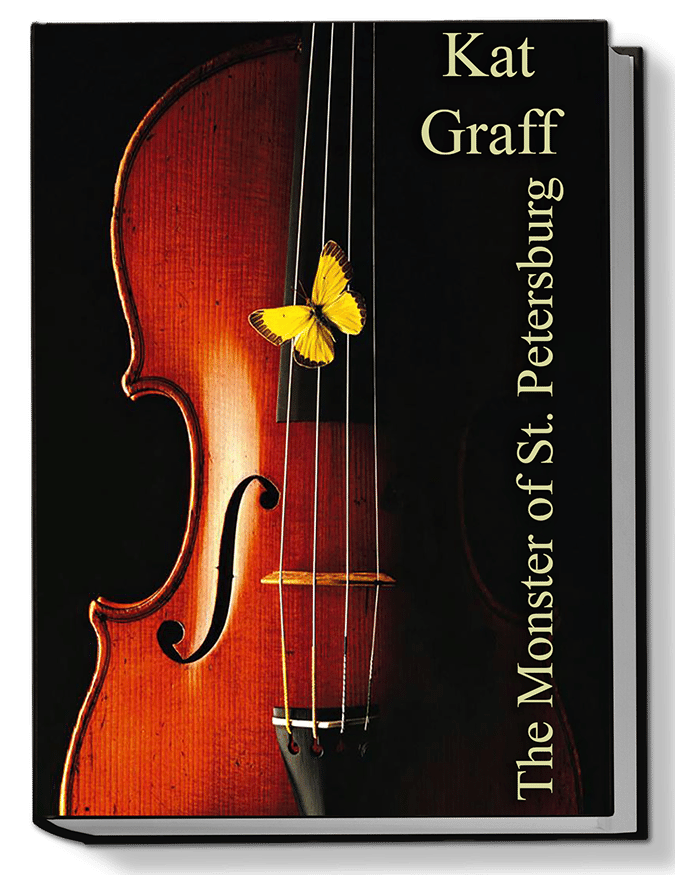
Eighteen-year-old Tatiana Abrikosova is a quiet, impoverished student at the University of St. Petersburg. Abandoned by her father and raised by an emotionally distant mother, she has grown up convinced that she is disposable. She has little money, no friends, and no experience of love; books are her only refuge. At the moment when the novel begins, she is absorbed in the life of Prince Grigory Potemkin and in the extraordinary partnership between Potemkin and Catherine the Great – a world of passion, intellect, ambition, and historical consequence that could not be further from her own.
Arkady Stasov, forty-eight, teaches Russian literature at Tatiana’s university. Brilliant, theatrical, multilingual, and irresistibly attractive to women, he is famous throughout St. Petersburg for his affairs. His reputation has earned him the admiring and faintly sinister nickname “the Monster of St. Petersburg.” He regards seduction as both an art and a game, and women as beautiful creatures to be awakened, enjoyed, and abandoned without unnecessary cruelty.
Their lives intersect when Arkady finds Tatiana unconscious on the floor of a confectionery shop. She has fainted from hunger. Intrigued by this awkward, unadorned girl, he imagines educating her tastes, awakening her femininity, making her fall in love with him – and then letting her go. Tatiana recognizes the celebrated professor but distrusts his interest. Nevertheless, she agrees to meet him again.
Their first encounters unfold against the palaces, churches, theatres, and historical ghosts of St. Petersburg. At dinner in the Yusupov Palace, Arkady tells Tatiana about Rasputin’s murder and the final blindness of the Romanovs. His stories make history immediate: not a procession of dates, but the accumulated choices of people who possessed power and failed to understand what they were destroying.
After dinner, Arkady takes Tatiana to his apartment. After using cosmetics left behind by Stasov’s former lovers, Tatiana unwittingly transforms herself into an innocent seductress, with no idea of the effect she has created. When Stasov, unable to resist her, kisses her, the accumulated nervous strain makes her vomit onto the very sofa where he once entertained the women he called his “butterflies.”
Fleeing into the night, she finally reveals the wound beneath her fear: her father discarded her so completely that she came to see herself as rubbish. Arkady’s intentions change. He promises that she has nothing to fear from him and, with tenderness neither of them expected, offers to become the fatherly presence she never had. Tatiana jokingly calls him Papa Carlo. What begins as a seducer’s experiment becomes a strange, fragile bond that is neither friendship nor courtship, yet contains the possibility of both.
Arkady introduces her to the city he loves: Peterhof, Tsarskoye Selo, the Gatchina gardens, old churches, music, theatre, and the private gatherings of St. Petersburg’s disillusioned intelligentsia. He also introduces her to his lifelong historical obsession – ьт Catherine the Great and Potemkin. The novel’s second narrative moves through their surviving letters, Catherine’s political and literary work, their probable secret marriage, Potemkin’s transformation of the empire’s southern territories, and the fierce intimacy that survived long after they ceased to be conventional lovers.
For Arkady, Potemkin represents a kind of greatness modern Russia has lost: wealth joined to creation, power joined to imagination, and love capable of making a woman sovereign rather than diminishing her. Yet the historical story is not an exercise in nostalgia. Through Catherine’s court, the fall of the Romanovs, and Arkady’s observations of contemporary Russia, the novel asks how empires confuse grandeur with moral worth – and how a nation that venerates its past can lose its living soul.
When Arkady leaves for a conference in Madeira, distance forces him to admit that he loves Tatiana. Even his acclaimed lecture on Catherine’s writings and her correspondence with Potemkin becomes inseparable from his thoughts of her. One final encounter with another woman leaves him ashamed of the identity he has cultivated. He decides that the Monster must die so that another man can return home.
During his absence, Tatiana also changes. Missing Arkady and frightened by the intensity of her attachment, she is baptized at the Alexander Nevsky Lavra and entrusts her love to God. A visit to her great-grandmother’s snow-covered grave brings ominous signs she does not understand. Meanwhile, Arkady returns to St. Petersburg, gives away his collection of dried butterflies – the emblems of the women he once captured – and clears his room of the remnants of his former life. He intends to marry Tatiana.
In the Summer Garden, he creates a small miracle for her: bright shawls, perfume, peaches, and a golden angel arranged against the snow. He tells her he loves her. That night, Tatiana discovers physical love not as conquest, but as trust, while Arkady discovers that passion can make him vulnerable rather than powerful.
Their happiness lasts only days. While buying a Christmas tree, Tatiana steps into freezing water. She soon collapses with pneumonia, and the doctors discover that untreated tuberculosis has already destroyed her lungs. No money, influence, or devotion can save her. Arkady takes her home to die, refusing to let her final hours belong to a hospital.
The modern tragedy is interwoven with Potemkin’s last journey in 1791. Ill and exhausted but still trying to complete his work, he leaves Iași in search of a climate in which he might breathe. Realizing he will go no farther, he asks to be taken from his carriage and dies in an open field. Catherine’s grief is absolute: she has lost not merely a former lover, but the only man who shared the weight of her vision and power.
Tatiana dies on January 7, Orthodox Christmas, still believing that she and Arkady have a future. While she lived, her love had stripped away the identity he once wore with pride: the metaphorical Monster had become a man capable of tenderness, responsibility, and faith. Her death reverses that transformation. Arkady ages with unnatural speed, his hair turns white, and the man Tatiana awakened gives way to an actual monstrous being. He abandons his violin, withdraws from life, and nurses a hatred of the God he cannot forgive. The name that once described a brilliant seducer becomes his literal fate.
Blending a tragic contemporary love story with a meticulously researched historical narrative, The Monster of St. Petersburg explores the difference between possession and love, spectacle and creation, imperial memory and spiritual life. Tatiana – the neglected girl whom no one considered important – becomes the measure of Arkady’s humanity. Her love turns the Monster into a man; her death turns the man into a monster.