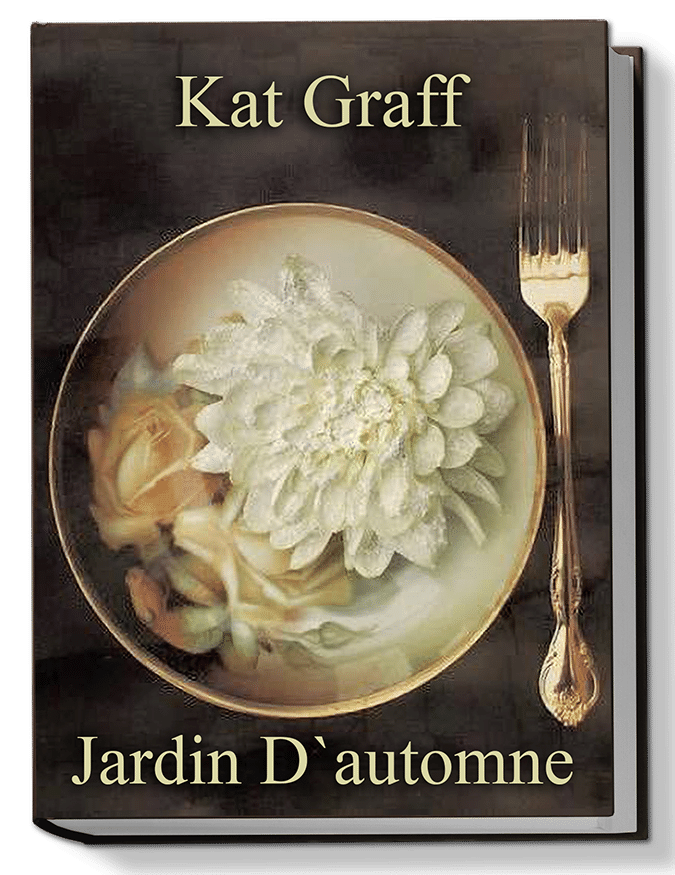
AUTUMN GARDEN - Jardin d’Automne
The Autumn Garden “I am an elephant,” the Old Man declares.
He is sitting on the veranda of his house in the faint warmth of the October sun. On the white tablecloth before him lie an old pair of field glasses and an open book. He is gravely ill and knows that he will die soon, although death refuses to disclose its day or hour. He has therefore decided to study for it. If he can learn how to stop loving life, perhaps he can also learn how to die.
His textbook is Wilbur Smith’s A Time to Die. The Old Man has little patience for most of the novel, but he repeatedly returns to the pages devoted to Tukutela, an aged elephant withdrawing from the world as his body fails. Tukutela accepts weakness, solitude, and the approach of death with an instinctive dignity that the Old Man envies. He tries to imagine himself as the elephant, moving toward his final refuge without protest.
The effort fails. Death has come too early, and the Old Man is furious. Human beings are given an immense appetite for life but no right to decide when they have had enough of it. He has not exhausted desire, laughter, pleasure, or curiosity. Why should the life that belongs to him be taken while he still wants it? The dying elephant may offer instruction, but the man remains rebelliously, inconveniently alive.
The field glasses are more useful than the book. Through them, the Old Man watches the house across the road, where a beautiful young married woman lives. Her veranda is crowded with hydrangeas, flowers, and plants that she tends with fanatical devotion. In autumn light, the balcony becomes a secret garden suspended above the street. Its beauty gives him temporary shelter from despair. When he dies, the flowers will continue to open and shed their leaves without knowing that a stranger once depended upon them for the strength to endure another day.
The garden is not his only secret. The Old Man is in love with the woman who created it.
He does not know her name and does not want to know it. To him she is simply the Woman: the final embodiment of every female beauty and freshness he has known. Through his binoculars he has learned the arrangement of her hair, the movement of her body, the moods that cross her face, and the quiet routines of her marriage. He waits for the moment when she turns her head so that he can read her expression and imagine the life unfolding inside the house opposite his own. His love is tenderness, voyeurism, desire, fantasy, and terror of extinction fused into a single late miracle.
The only other person in the Old Man’s life is his nurse, Edith. She is an elderly Frenchwoman, short, thin, sharp-chinned, black-haired, deeply wrinkled, and formidable. Her patient privately invents cruel jokes about her appearance, but he also knows her value. Edith disciplines his days, argues with his moods, and remains beside him through attacks of pain that tear apart his body and disorient his mind. When he refuses morphine, she respects the decision, condemning herself to nights of helpless attendance while he suffers. Once the agony passes, he watches her asleep in a chair and feels grateful for the ordinary hours she has helped return to him.
Their quarrels have become a form of intimacy. Edith insists that his failing body requires order. He answers that discipline is the fate of lonely people. When she observes that they are both alone, he tells her that death has recently become his closest companion and has liberated him from rules.
Yet Edith knows that death is not his only companion. She has understood what the binoculars are for and longs for him to confide in her. Her curiosity is mixed with hurt. She cares for him, shares the private hell of his illness, and is summoned whenever pain overwhelms him, while his secret adoration belongs to a young woman who does not even know that he exists.
In her room, Edith watches wildlife programs and cries over an injured goose whose mate welcomes her home after the amputation of a wing, apparently indifferent to her altered body. The story touches the wound Edith has carried all her life: the fear that love belongs only to the beautiful, while someone like her may serve, endure, and remain loyal without ever being chosen.
One morning two uniformed telephone-company workers arrive at the house opposite. The Old Man and Edith watch as the Woman lets them into her study and then returns to her garden with a jar of yogurt. While one man keeps watch, the other opens a drawer in her desk, finds a velvet jewelry box, and removes a pair of diamond earrings. The theft is calm and precise; the men clearly knew where to look. They even accept payment for their supposed repair before leaving without issuing a receipt.
The Old Man appears outraged. Edith is frightened and proposes action, but he is interested chiefly in when the Woman will discover her loss. Then, with sudden secretive delight, he asks Edith to dress and perform a favor for him.
By now he finally admits what she already knows: he loves the Woman. The confession releases him. He is not ashamed of his absurd late passion; he is proud of it. In return for his honesty, the nurse gives him her name, and from that moment she is no longer merely “Nurse” but Edith, the first initiated member of his conspiracy.
The Old Man tells Edith that the Woman and her husband may be in danger. He claims to have watched the husband meet suspicious men at the end of the street, receive envelopes of money, and sit smoking in his car before entering the house. The marriage appears loveless: the Woman does not greet him, they eat and sleep apart, and he seems afraid of speaking to her. The Old Man suspects drug trafficking. Edith wants to call the police. He refuses. They must wait, observe, and be ready to help the Woman themselves.
Edith also wants to know whether her patient’s passion has a right to exist. She asks about his wife.
The Old Man is American. When he was about thirty, he worked in narcotics enforcement in San Francisco, pursuing drug barons and intercepting routes from Southeast Asia. He met Michelle, a seventeen-year-old French girl visiting relatives in the United States, and at first saw her as a temporary romantic adventure. Then he discovered that she was an addict.
He locked them both inside his apartment and spent seven weeks taking her through withdrawal. The ordeal changed him. His work had required him to kill so often that, without noticing, he had lost contact with his own life. Saving Michelle returned him to it. When the crisis ended, they should have separated; instead, they married. Years later Michelle died alone in the French house where the Old Man now intends to die. Neither her husband nor children were beside her. He does not seek repentance for that failure. Faced with death, he wants only to love and he is terrified of dying alone.
His former profession also took him to post-Soviet Russia with an Interpol team. The memory of drug routes stretching out of Central Asia, the misery of those trapped at the beginning of the supply chain, and the human lives consumed by the trade still disgust him. He has seen suffering, violence, and degradation at close range. He has also killed with the pistol now hidden in a drawer of his bedroom table.
Meanwhile, the Woman discovers that her diamond earrings are missing. Through his field glasses, the Old Man watches her search the study and finally understand that she has been robbed. That evening a deliveryman arrives at her door with roses, white amaryllis, and a small ribboned box. Inside is another pair of diamond earrings, purchased by Edith at the Old Man’s request.
He dresses formally and waits at a beautifully laid table on his veranda, expecting some sign from across the road. For a long time, nothing happens. Disappointed by the apparent failure of his own cleverness, he begins to retreat into the role of the dying elephant.
Then the Woman appears among the leaves and blossoms of her autumn garden. Her hair is gathered at the back of her head; the new earrings shine in the soft evening light. She has solved his riddle. Her expression contains surprise, amusement, and gratitude. Love strikes the Old Man so violently that it becomes pain.
Looking at her, he makes a private wish. If death is followed by another life, he wants to return as her child. Only within her body, he imagines, would he feel safe waiting in darkness for existence to begin again. The fantasy soon becomes more earthly and more audacious: before he dies, he intends to create love and leave behind its living fruit.
For this, he needs Edith.
He begins questioning her about the family she left behind. Edith comes from Entre-deux-Mers, between the Garonne and Dordogne rivers, where her family owns more than twenty hectares of vineyards. Her mother was ashamed of her appearance and treated her as une méprise, while her father loved her without reserve. He left Edith half of the family enterprise, a share of its capital, and the house. Her two older brothers never threatened her openly, but humiliated her so persistently that, while still young, she surrendered her rights and left.
The Old Man immediately sees the future he intends to manufacture. Edith is still the legal heir to vineyards, money, and a family estate. She can reclaim them. The son he plans to father before his death will inherit his own fortune and grow up with the Woman in a fine house among vineyards. Edith, who has spent her life without a family, will care for them and raise the child as her grandson.
One further fact delights him: Edith’s father taught her to shoot. She once could hit the center of a target from thirty paces. The Old Man tells her where his pistol is kept and asks her to surrender it to the authorities after his death. Edith promises, unaware that her marksmanship and knowledge of the weapon are already part of his scheme.
Like Tukutela, the Old Man believes every living creature is entitled to one final battle. His house will be the site of his. But unlike the elephant, who eventually ceased seeking females and wandered alone, the Old Man’s longing has intensified. Physical intimacy has become an obsession and proof that he has not yet departed from life. He abandons Tukutela as a teacher. He no longer wants to learn surrender.
Across the road, the Woman cuts the flowers from her autumn garden and arranges them in tall vases. To the Old Man, the stripped garden seems packed for departure. He believes her devotion to fragile plants reveals her own vulnerability: unable to defend or define herself, she transforms fear into the creation of beauty. He loves her weakness even as he judges it, assuming that some women are made to be protected by stronger men.
Edith, however, has begun imagining the family he described. His madness awakens her own buried desire. She will return to her brothers, demand the inheritance her father left her, build a home, care for the Woman, and raise the promised child. She tells the Old Man that she agrees.
At noon, the two telephone workers reappear. They seize the screaming Woman and drag her slowly toward their van. The street is empty. Pretending to suffer an attack of pain, the Old Man orders Edith to fetch the pistol. These men, he insists, are about to destroy not only the Woman but the future Edith has already allowed herself to love.
Edith runs to the bedroom, grabs the weapon, and fires from the balcony. She deliberately aims into the air. To her astonishment, one of the supposed kidnappers collapses and clutches his leg as though wounded. The shot gives the Woman time to break free. She runs across the street and into the house where the Old Man is waiting.
Standing in the rain, Edith understands everything.
The men are not telephone workers, thieves, or kidnappers. The Old Man hired them. The first pair of earrings was never truly stolen; it must be hidden somewhere in his house. His story about the husband’s drug dealings was probably invented to frighten Edith and transform his own violent past into heroic evidence. The staged abduction had been planned before he asked whether she could shoot. The men dragged the Woman slowly so that Edith would have time to retrieve the pistol, and the false victim’s theatrical wound has betrayed the entire performance.
The Old Man has manipulated Edith’s trust, exploited the betrayal that once drove her from her family, and risked having her shoot an innocent man. Furious, she picks up the pistol and returns to the drawing room.
The Old Man is sprawled in his chair, his long white hair scattered across his shoulders, radiant with happiness. The terrified Woman stands before him like an orphan in immediate need of love, shelter, and protection. Trembling, she turns to Edith and whispers her thanks.
Edith sits down with the pistol in her lap and looks into her patient’s eyes. His triumph gives way to a silent plea. He asks her not to expose him, not to betray the shared dream that his deception has made possible. He could not have revealed the plan in advance: she might have refused, or played her part without the natural terror necessary to make the Woman believe in her rescue.
Edith now possesses the power to end the farce. She can tell the Woman the truth. She can summon the police. She can punish the dying manipulator who has used her loneliness as one more instrument in his final production.
Instead, she chooses the dream.
Her anger dissolves before the possibility of a family: two lonely women, perhaps a child, and the Old Man’s presence continuing beyond his death. Honesty, she decides, would yield very little under these circumstances. His conduct is indefensible, but his madness has opened a door that reason, decency, and obedience never opened for either of them.
“In the name of love,” the Old Man says.
“Amen,” Edith answers.
Together they turn toward the Woman. She has begun to recover from her fright, although curio sity now mingles with fear. She studies the strange pair before her: the dying libertine with disordered white hair, looking at her with adoration and desire, and the old nurse, gazing at her with love while still holding a pistol.
Jardin d’Automne is a darkly comic chamber novella about mortality, desire, loneliness, manipulation, and the human hunger to leave something living behind. The Old Man’s conspiracy is selfish, tender, dangerous, ridiculous, and strangely generative. Edith’s final choice does not make the deception innocent; it reveals how desperately people may prefer an impossible future to an orderly life without love. Reason and love may both be divine gifts, but when human beings force them to occupy the same room, love often drives reason mad.