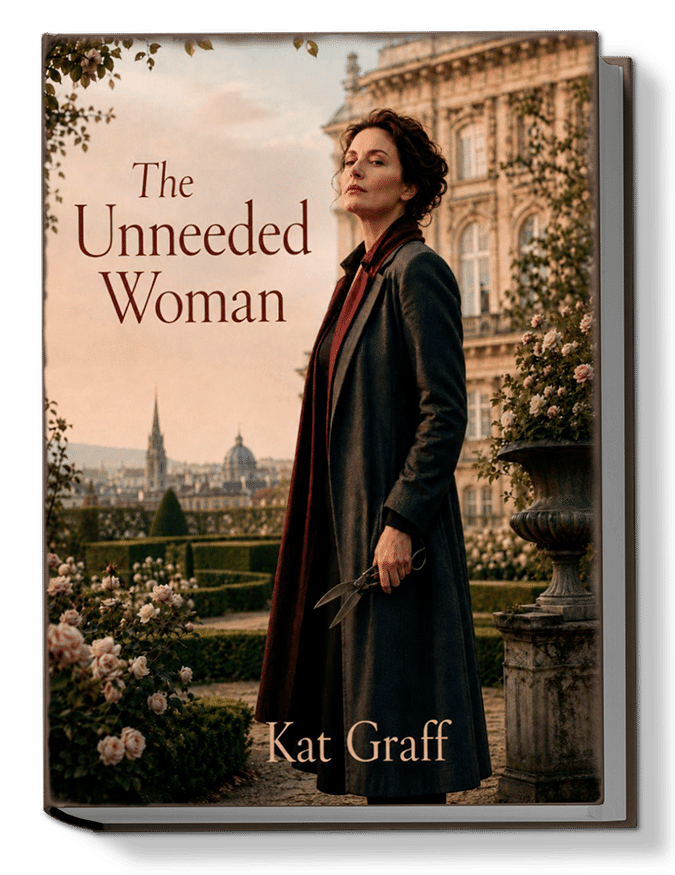
The Unneeded Woman
In Vienna’s Café Diglas, a woman in her forties sits alone at a table. She is still beautiful, but her beauty is guarded by irony and distrust. An American man who has been watching her approaches with an awkward offering: a slice of the café’s redcurrant cake. She refuses the cake, but not the conversation.
The woman is married to a Greek. The man is American, wealthy, and alone. He is immediately fascinated by her intelligence, her bluntness, and above all by her complete lack of interest in winning him. When he invites her to walk through Vienna with him, she hesitates – not because she is married, but because she avoids new attachments. “My husband is enough humanity for me,” she tells him. “He embodies all its horrors.”
Her name is Olga, but the American dislikes it. To him, it evokes Chekhov’s women: waiting, searching, unable to find a place in their own lives. He gives her another name, Lutetia, which he imagines as a rare flower on a long stem. He introduces himself only by his nickname, Taurus. From the beginning, he is not simply getting to know her. He is inventing her.
Olga has spent years being moved from country to country like a piece of furniture by her husband, Aristotle, an elegant but indolent corporate executive. Multinational companies repeatedly hire him at impressive salaries, admire him for several months, discover his emptiness, and dismiss him. Each new appointment briefly restores the couple’s prosperity; each dismissal brings unemployment, humiliation, and fear. Now approaching old age with no savings of her own, Olga dreams of leaving Aristotle and living alone. The obstacle is brutally practical: she cannot afford independence.
For her, solitude promises a sterile safety. No one will betray, disappoint, or abandon her; no one will love or care for her either, but she has long since learned to survive without that. Taurus challenges this philosophy. People rarely receive love in the form they desire, he tells her, because those who love us offer their own version of it. Olga remains unconvinced. During their walks through Vienna, the two test each other through arguments about faith, the church, charity, responsibility, sexuality, poverty, power, and the sovereignty of an individual life. Their conversations become their form of intimacy.
The meetings grow regular. Taurus is already imagining a shared future, while Olga refuses to promise one. She is drawn to his force and intelligence, yet wary of the price of accepting his protection. When he takes her to his large house, she discovers that his fortune was made by selling weapons after the collapse of the socialist bloc. He speaks of building a chapel and devoting his later years to charity. Olga immediately sees the contradiction: good works financed by the suffering his weapons helped create.
She also sees that his magnificent house has no soul. Taurus calls her the soul it has been waiting for, but Olga imagines the life he offers—gardening, domestic rituals, comfortable evenings – and recoils. It is not poverty she fears now, but the possibility of spending the rest of her life beside another man she does not need.
Taurus loves her, but her independence offends him. He wants a love founded on need: the unquestioning attachment he once felt for a childhood puppy, the joy of knowing that another living being cannot be happy without him. Lutetia, as he has created her in his mind, must depend on him, submit to him, and fight to keep him. Olga, who can release any desire or person rather than become their prisoner, is not the woman he wants. He decides to remake her.
At the Hotel Sacher, Taurus seeks out Aristotle. Beneath Aristotle’s cultivated appearance lies a man exhausted by the effort of sustaining a life for which he has neither discipline nor desire. He resents Olga’s contempt and secretly dreams of escaping their marriage. Taurus offers him a five-figure sum to stay at his house for some days and participate in a carefully designed game. Aristotle accepts. The money promises freedom; the game promises revenge.
Olga tells her husband that she is leaving him. Instead of grief, she sees relief on his face. Aristotle announces that he, too, has been invited away. She moves into Taurus’s house with her beloved cat, but insists on a separate bedroom. She trims the garden shrubs every morning with long, sharp shears, slowly acquiring the habits of someone putting down roots. Taurus believes she may finally be growing attached to him. Yet the machinery of his plan is already in motion.
One morning, in a supposedly closed wing of the house, Olga sees Taurus and Aristotle breakfasting together in their pajamas. Taurus strokes Aristotle’s cheek and kisses him. Olga’s first response is not jealousy but a flash of exhilaration: if Taurus has betrayed her, she is free. Then her analytical mind begins to work.
She reconstructs their relationship from the beginning and understands what Taurus expects. The kiss is theatre. Aristotle has been installed as a rival who will awaken her jealousy, threaten her new security, and force her to fight for Taurus. When she confronts him, Taurus admits the design. He wanted her to be horrified, to tear him from Aristotle’s arms, and to prove that she loved him.
Olga tells him that he has never seen her at all. He invented Lutetia, just as he invented a soul for his house and a new identity for himself in Europe. He surrounds himself with illusions, believes in them, and then manipulates real people until they fit the world he has created. He has not loved Olga; he has loved his own creation.
Frightened now by the scale of his need for control, Olga pretends to surrender. She promises to stay and love him if he sends Aristotle away. Secretly, she plans to pack her suitcase, take her cat, and escape. But she senses that the game has not yet reached its true ending.
The following morning, Olga goes into the garden carrying her shears. Aristotle approaches. Taurus crosses the lawn toward them and dismisses him, allowing him to keep the money. In one sudden movement, Aristotle drives Olga’s hand forward. The blades plunge beneath Taurus’s ribs. Olga falls beside him, still gripping the weapon, while Aristotle calmly collects his luggage and leaves in a waiting taxi.
Taurus, lying wounded on the ground, offers the authorities a story: he stumbled while trimming the shrubs and fell on the shears. Olga finally understands the entire construction. The staged kiss was only the first act. The wound was intended to make her both apparent criminal and helpless victim. Aristotle would vanish with the money; Taurus would protect her with his false account; and Olga, terrified that he could expose her at any moment, would be bound to him by gratitude, guilt, and fear. Taurus wanted to build the invisible walls within which Lutetia would finally give him the dependent love he demanded. Aristotle agreed because he wanted Olga to experience the. imprisonment of a loveless relationship as he believed he had experienced it with her.
Taurus calls her closer and, at last, tells her his real name: Sam. Olga kneels beside him, takes hold of the shears, and deliberately drives them deeper, until their points enter the earth beneath his body.
“Everything will be all right, Sam,” she says, and walks into the house to call the police.
Olga has spent her life as a prisoner of her dream of solitude. Sam has offered wealth, protection, and love, but only on the condition that she surrender the self he claims to adore. In the final act, the “unneeded woman” chooses responsibility for her own crime over captivity inside another person’s fantasy. Sam succeeds in making her need to act—but he never succeeds in possessing her.